
Let's Read ... Three Essays Still Pinging
E248: Future of Work + Raising Future Ready Leaders + Climate

File under: Essay candy
The Substack algorithm delivered: I found three essays worth sharing - one through a note from Oliver Burkeman (Meditations for Mortals and 4000 Weeks); another was restacked by almost everyone in my circle; and the third …can’t recall how I tripped over this one, but it elegantly echo’d everything I’d been thinking since 2014 and discussing over the past five years.
So, in a week when you, too, maybe busy with futbol/ games, the Knicks win(!!), birthday parties, or watching the sun gently unfurl the petals on your patio planters, enjoy this little stash of Essay Candy1.
These essays connect my dots …
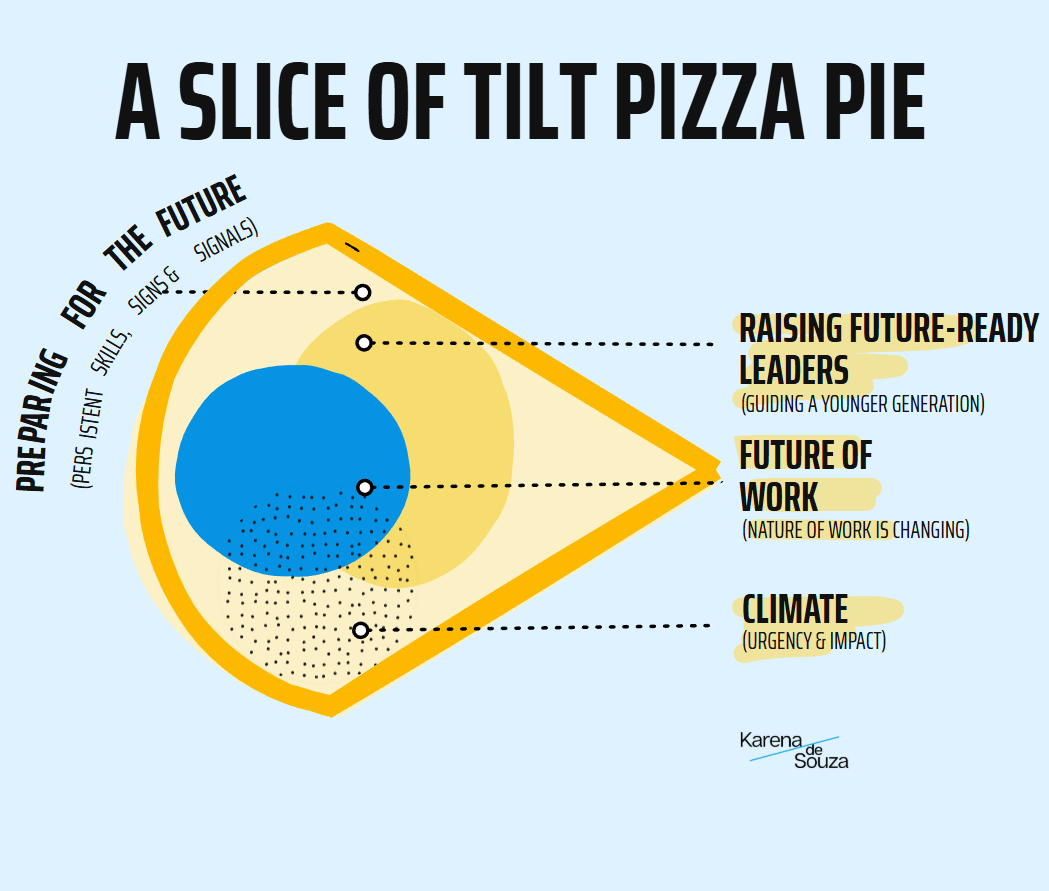
As a reminder, Tilt the Future covers three main topics. You begin to see how these essays connect all my talking points:
For the many members of our Tribe who are not on the Substack app, here are the three essays:
Rutger Bregman’s An Inconvenient Truth About AI (everyone is reading)
Scott Barker’s You don’t need a job in the future (my discovery)
Misha Glouberman’s How Worried Should You Be About Climate Change? How Worried Should I Be To Talk To You About It? (Oliver Burkeman recommendation)
The first two essays pair together around a message of hope and some tactical suggestions as we raise ourselves, and our nextGen to create a community of Future-Ready Leaders.
1: Rutger Bregman’s An Inconvenient Truth About AI
When we met in Goa, Ishita Singh gifted me her well-worn copy of Rutger Bregman’s Utopia for Realists with her scribbled notes in the margins. It kept me company on the long flights back home to Toronto, via Delhi and Tokyo. Thanks, Ishita!! I’ve long been entranced by Bregman’s deep thinking, long view and, in particular, his way of bringing history into discussions of our future.
Bergman has turned his latest essay, An Inconvenient Truth About AI, into a written and YouTube essay.
The essay itself is about the speed with which AI models are advancing — and the danger of downplaying this as a bubble that will disappear, and not inserting our voices loudly enough today into the discussion on safety for children and adult use as this new toy/technology rolls out. I do not use the word ‘toy’ lightly - many people talk about their engagement with the latest AI model as my 12-year-old used to talk about the kids in school boasting that they had the latest Nintendo DS. It sometimes smacks more of elitism and entitlement than true use case. (Not all, though - looking at you, Becky Isjwara, for instance!)
Why this essay mattered to me:
… my fellow progressives in Europe [and Canada] really need to understand that our welfare state, our way of life, is at stake. Just think it through. If AI does much of the work, but the profits flow to a handful of American giants that we barely tax – while European workers lose their jobs – then the tax base that funds our healthcare, our pensions, our unemployment insurance just… evaporates.
This point in the essay felt like it jerked me back to a moment in 2015 when I realized why I was personally pivoting to a broader discussion about the Future of Work. With gig work on the horizon, the math would no longer be mathing. Government programs are set up on a predictable rate of income, and that goes away when gig work and underemployment become the norm.
Sections that are doing cartwheels in my brain:
… this is the largest capital build-out in the recorded history of our species. It’s larger than the interstate highway system. Larger than the International Space Station. Larger than the Moon Landing and the Manhattan Project combined, and it is not even close. [You gotta see the graph]
The railway bubbles of the nineteenth century ruined lots of investors. They also created a rail network that powered the Industrial Revolution, the tracks of which still carry trains today. I actually don’t think this AI build-out is a bubble, but even if it is, remember: bubbles build infrastructure. Bubbles build the future. And a bubble of this magnitude, bursting tomorrow, would still leave us with a civilization permanently reorganized around machine intelligence.
The fiscal bargain that built every democracy on Earth could very well dissolve.
The whole point of building the most productive economy in history was that we would no longer have to spend our lives doing work that bored us, just to put food on the table. [And yet, during Covid-19, we saw how many were left struggling with more than one job, so that they could put food on the table.]
2: Scott Barker’s You don’t need a job in the future
Scott Barker ‘s essay was my surprise discovery read [thank you, Substack algorithm!]
One of my earliest Big Thinks around the idea of the Future of Work was a worry: if we move into gig work, if Universal Basic Income (UBI) was one of the possible solutions, if we decouple receiving money for the time we work, how do we value work? It led me to conversations in my head on “How do we ensure our children retain their sense of self and understand their value?”
That thread led me to talk about the impact of the Future of Work with parents and guardians, rather than the more lucrative employers and MBA grads. Our internal messaging - the one that runs the internal conversation in our heads - is pre-programmed by early-life conversations. I created a little alliterative phrase to make it more memorable:
The voice we hear in our ear at fifteen
Echoes in our head when we are fifty.2
“Oh, I call that the Mommy voice,” said a Harvard professor when I described the work I was doing with high school educators and PTAs, “You should also be talking to elementary school parents.”
Language matters. Phrasing and framing matters. That is why something in the middle of my soul resonated deeply when I read Scott’s words:
We have to reframe how we think about our careers.
Where there is work to be done, problems to be solved, there is an opportunity to make a livelihood. So what kind of work would you like to spend your life doing?
Exactly! Hark back to a point I made recently “See a problem, solve a problem.” Job security!
He created great lists, and here are some other parts of his essay that made it great reading:
Reclaim your nervous system
Find a big problem that you feel passionate about
Aquire the skills needed to have an impact on that problem
Make you passion for this problem known
Do not wait for permission, start solving the problem now
Nobody can take your passion about your problem away from you, nobody can fire you from your problem and your knowledge of this problem will start to compound over time. And, most importantly, you may start to find deep meaning in your work.
There is so much good, actionable stuff in his essay!
More on the Future of Work:
![Mind the [].. Generation ..[] Gap](https://substackcdn.com/image/fetch/$s_!Hu3I!,w_140,h_140,c_fill,f_webp,q_auto:good,fl_progressive:steep,g_auto/https%3A%2F%2Fsubstack-post-media.s3.amazonaws.com%2Fpublic%2Fimages%2F2e47cfa5-9392-4b24-a70c-c1ace7bd6388_6000x2536.jpeg)
3: Misha Glouberman’s How Worried Should You Be About Climate Change? How Worried Should I Be To Talk To You About It?
Maybe it is something in the water, because Misha Glouberman is also Toronto-based.
Many years ago, I learned a powerful lesson from a roomful of older adults - a climate scientist, an architect of Canada’s paper at the 1992 Rio Earth Summit, a member of the team that put the Canada Arm into space, an environmental consultant among them - the headlines are not necessarily the data. At the time, I was one of the youngest members of ALLTO.ca - the Academy for Lifelong Learners, TOronto. In a room of people who would normally be international panelists at a Climate Conference, we were co-creating a 10-week class on “Climate”. Each week, a member of the class would present on a topic of their choice. Each week, I watched leaders in their field humbly learn from the innocent inquiry of younger participants or those whose life’s work had been in a different discipline.
What they taught me, through modelling, was how to “hold strong opinions lightly”. How to balance the urgency of climate action with the agency that ensures we do not inadvertently create Climate Anxiety that is so debilitating that it stops us dead in our tracks.
Misha’s article transported me back to those lively debates in that pre-Covid in-person class - when you held the eye and attention of the person you were conversing with.
From the reading list below, you get that I am Team Climate Activist. I appreciate Misha’s bold move in publishing his thoughts, and it is one of the reasons I like reading essays over Instagram Reels … I am called to a deeper conversation within myself, rather than a knee-jerk reaction. It is the same conversation that started my journey into climate, and landed me on the book “Saving Us - A Climate Scientist’s Case for Hope and Healing in a Divided World” by Katharine Hayhoe (originally from Toronto … just saying!)
If you liked this, you may want to explore some of my other climate rants essays:

We often talk about heirloom skills - “heirloom” handed down from one generation to the next; hard-won; the more often they are used, the better the burnish. Skills that have an intergenerational life, balanced with our constantly changing but also necessary technical skills.
Your turn “}…{`
Did these essays hit with you too? If so, which were your resonant sections?
And have you come across something good that you would like to share with others?
Did you know I keynote on Future of Work and 21st-century skills?
Invite me to speak at your next conference, round table discussion, or podcast.
A warm welcome to our new members!
Here, in Tribe Tilt, we believe in the best of humanity - connecting people, sharing ideas, and respectfully exploring thoughts, knowing that a great idea can come from anyone, anywhere, at any time. Thank you for joining us. You have self-selected into a powerful, group committed to making a difference to the people and places that are precious to us.
Stay healthy. From there, all else becomes possible.
And I’ll see you again next week
What is Essay Candy? Some essays stick with you. Either because the message was something you needed to hear in “just that moment”, or because the structure of the essay stuck with you like a musical ear-worm. Or both. More about this tag here:
Do You Want To Share My Secret Stash of Essay Candy?

I feel like one of my kids in the weeks after Halloween. There - in the nether-reaches of the back of their closet - is a big brown bag filled with their favourite candy. Out of the total selection offered on 20 different streets and probably 300 homes, this is their personal stash, the candies that they reserve for their special moments. I’ve been doin…
Don’t believe me? Do you ever feel like your Mom is invisibly sitting in your head? The quote came to me as I was losing the golden hour light. I’d had a bad hair day, and with each repetitive take I kept trying to tame the straggling strand … because I could hear my mother’s expectations in my head. A mother who was sitting across an ocean, and who wasn’t the target audience for my video!
Thank you for 3 must read recommendations. ok, I'm still on the first one but already compelled to comment 😂. It's such a clear-eyed realist view of the optimism and perils of AI. I love his prescription that what we need is a positive vision that we should try to manifest. In fact, I think that's one of the failings of the original Inconvenient Truth too - it was a little too much gloom instead of pivoting to a "let's take this opportunity to create a solarpunk future"
Thank you for adding to my reading list!